

The Railway Era

Image source: The Weekly Courier, p. 18, 28 May 1914.
Rail first came to Macquarie Point in 1876 with the completion of the railway connecting Hobart and Launceston. A Royal Commission held a decade earlier determined the route. Despite pressure from local aldermen to locate the Hobart terminus at the Market Place, now the site of Hobart City Hall, the Macquarie Point was selected instead.
Several options were considered for the final section of the route. One would have required a tunnel to avoid the hill of the Domain. The preferred route instead skirted the Domain along the foreshore.
In 1900, the Tasmanian Government took over the Tasmanian Main Line Company. The railway became a major employer, providing work for train crews, tradespeople, engineers, apprentices, fettlers, signalmen, clerks, stationmasters and porters.
By the early twentieth century, the old railway yard was considered too small and unsafe. Major expansion works transformed it into a transport hub for freight and passenger services, supported by growth in Tasmania’s fruit industry.
The works included the demolition of the old Engineers Yard and the construction of a roundhouse and Goods Shed in 1915. The roundhouse was particularly notable as it had the largest electrically driven turntable in Australia.
Goods Shed
The Hobart Railway Goods Shed was constructed between 1914-1915 as the centrepiece of major expansion works at Macquarie Point. The original timber-framed building was 300 feet (approximately 91 meters) long with 25 structural bays, designed to handle the growing volume of goods transport, particularly fruit exports from across Tasmania. The facility was integral to the state's rail network, handling everything from agricultural produce to raw materials for the Cadbury chocolate factory at Claremont from 1922 onwards with significant modifications and alterations made to the building from the 1940s-1960s.
The building's function changed in 1978 when the Australian National Railways took over Tasmania's rail operations, leading to widespread rationalisation and the eventual cessation of rail freight operations.
In 1984, the Goods Shed was converted to a transit warehouse for road transport use, with most loading bay openings filled in, the exterior reclad in corrugated steel, and rail access completely removed.
After railway operations ceased entirely at Macquarie Point in 2014, the building found new life under the Macquarie Point Development Corporation, and has been used as office space and as a popular venue for community events including concerts, exhibitions, and corporate functions, representing its evolution from industrial infrastructure to cultural and commercial space.
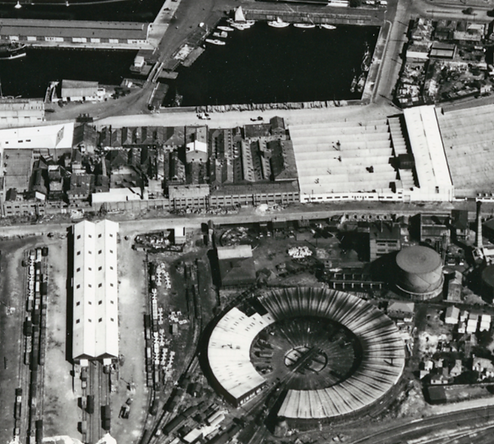
Image source: Aerial View of the Hobart Wharves, February 1952, photographer unknown, Tasmanian Archives (TA), PH 30/1/4436.
The Goods Shed will be carefully packed down with heritage components labelled, catalogued and stored. The original elements of the shed will be restored and relocated at the northern end of the stadium development near the location of a former train maintenance shed.