

Macquarie Point's European history
Macquarie Point played a key role in Hobart’s evolution. Initially part of early land grants issued, the first recorded European development at Mac Point was Leonard Fosbrook’s farm, established by 1806.
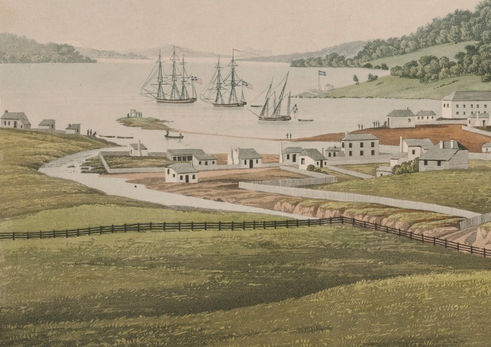
Image source: George Williams Evans' depiction of early Hobart Town, South-west View of Hobart Town, 1819, George William Evans, State Library of New South Whales (SLNSW), DG V6-1, a1528621.
Fosbrook was the Assistant Commissary and was responsible for managing the government stores.
His cottage strategically overlooked the government store on Hunter Island.
In 1815, the land was acquired by Edward Lord, one of the colony’s wealthiest residents.
Lord built a grand house on the site, possibly incorporating Fosbrook’s earlier cottage.
In the early days of the colony, Mac Point was a farm, quarry and school. Governor Lachlan Macquarie later identified the site for government use, and it became the government’s principal works depot.
Lumber Yards
Known at different times as the Lumber Yard, King’s Yard, Queen’s Yard and Engineers Yard, the site was established as a focal point for convict labour.
The Lumber Yard was constructed in 1826–27, along with a slipway on the River Derwent that allowed timber to be brought ashore from ships.
The yard consisted of a large open square enclosed by buildings and workshops. For years, convicts carried out skilled trades including blacksmithing, carpentry and furniture making.
The workshops were used by turners, nailors, carpenters, sawyers, wheelwrights, tinsmiths, armourers, painters, glaziers, coopers, saddlers and harness makers. Examples of furniture made by convicts at the Macquarie Point site are held in the collections of the Tasmanian Museum and Art Gallery.

Image source: Chart of Sullivans Cove and Part of Hobart Town Showing the Intended Improvements, date unknown, John Lee Archer (Surveyor), Tasmanian Archives (TA), AF394-1-169.
Royal Engineers
In 1835, Tasmania had the distinction of receiving the first Royal Engineer in the Australian colonies who was stationed in the state to oversee British colonial construction projects.
Initially, the Royal Engineers designed, constructed and maintained convict and military buildings, fortifications and hospitals. During the 1840s, their role expanded to include civil government works and the maintenance of provisions for troops and convicts.
By 1847, Tasmania had 3,000 troops and 20,000 convicts, and the Royal Engineers needed a larger headquarters.
A purpose-built, two-storey sandstone building was constructed beside the Engineers Yard and was used by the Royal Engineers until the early 1870s.